Press Kit
Press Resources
Resources for journalists and analysts covering Nexus Telemetry and the broader Starlink ecosystem. For specific questions or interview requests, see the press contact below.
About Nexus Telemetry
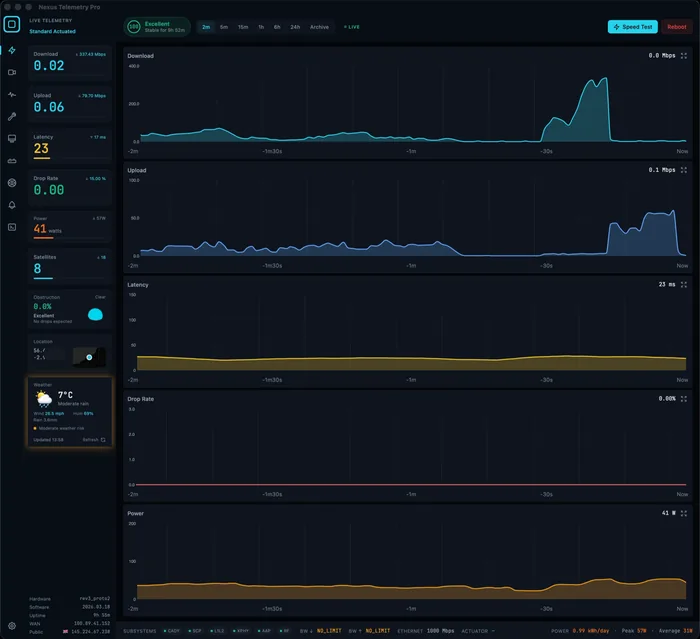
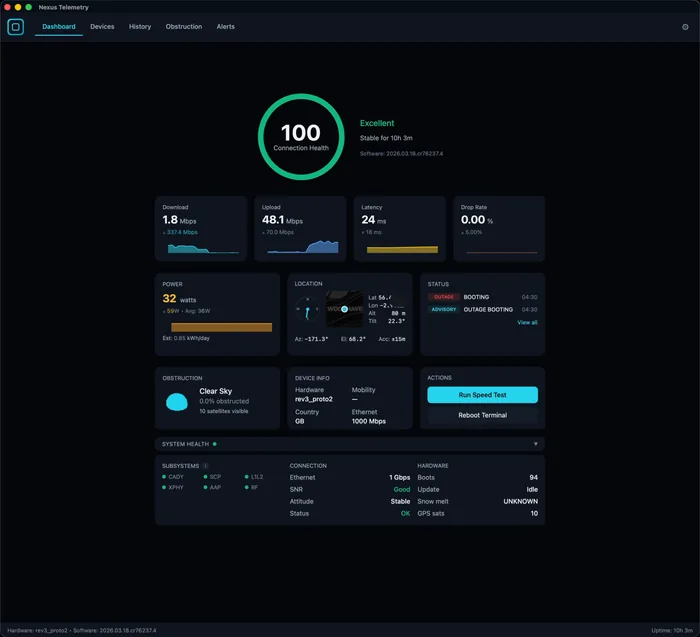
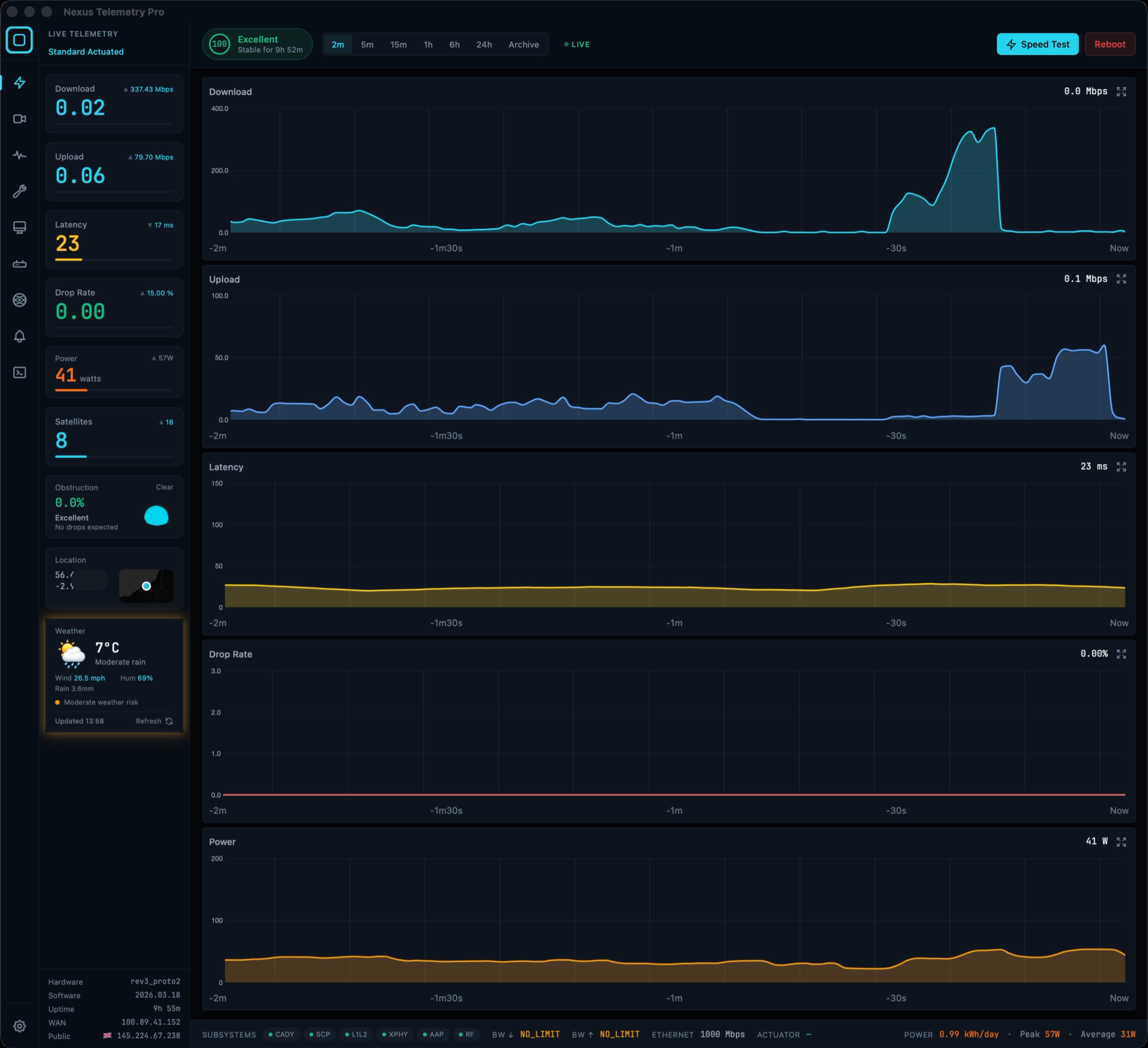
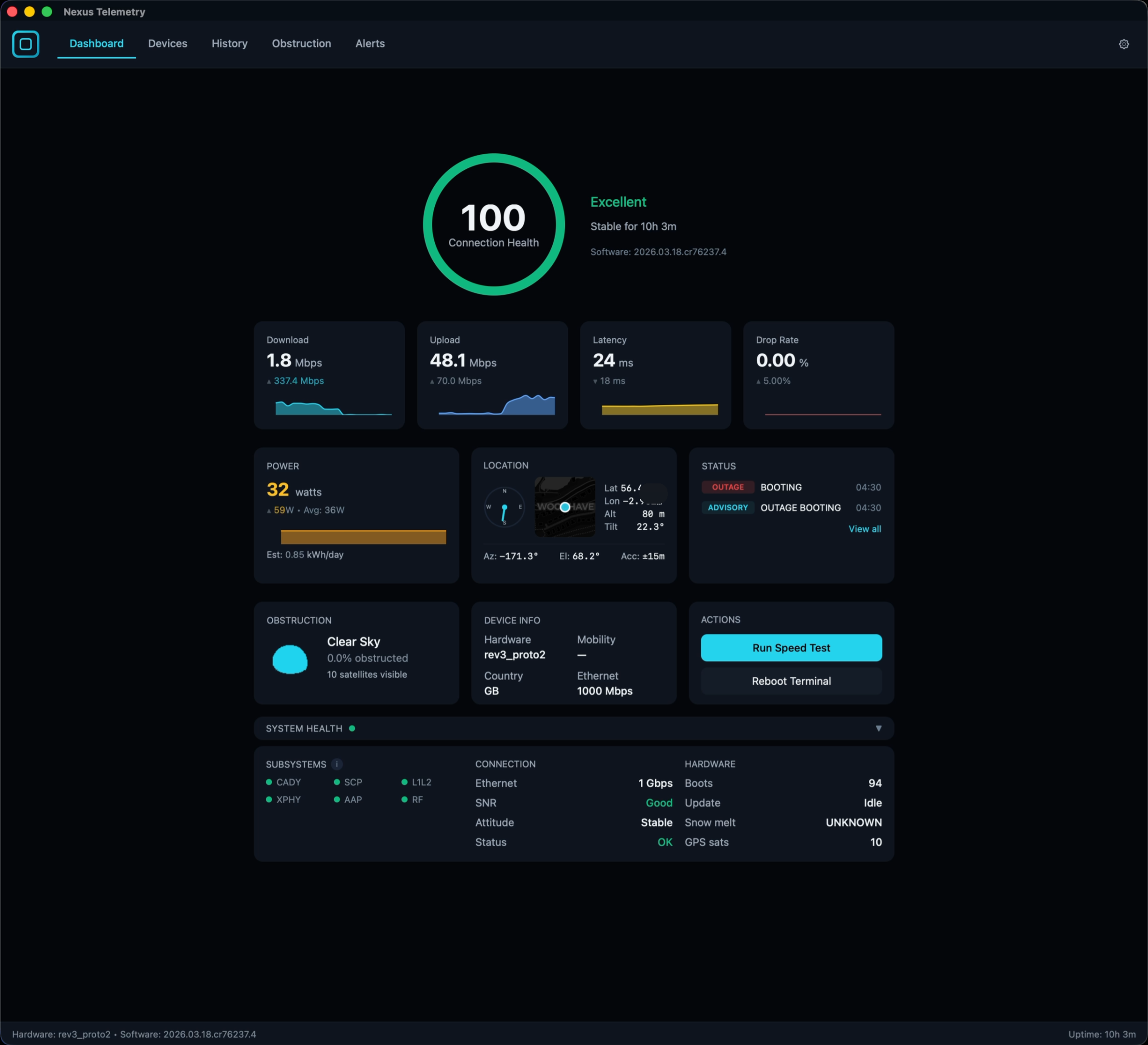
Nexus Telemetry is a native desktop application for monitoring Starlink satellite internet connections. Built in Rust, it runs on macOS, Windows, and Linux, connecting directly to Starlink hardware to provide real-time telemetry, satellite tracking, speed testing, obstruction mapping, and network diagnostics.
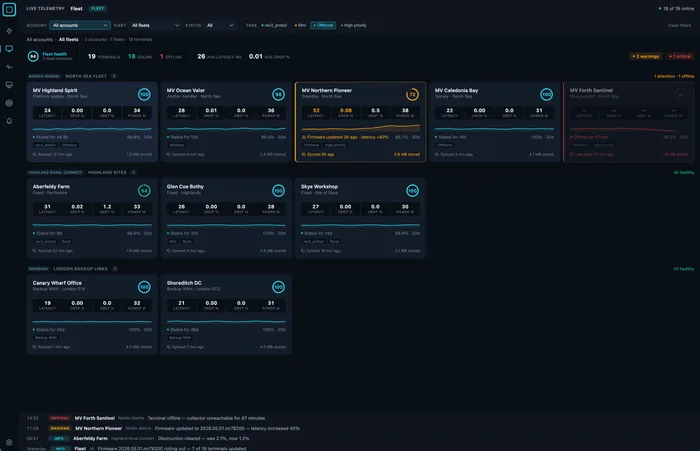
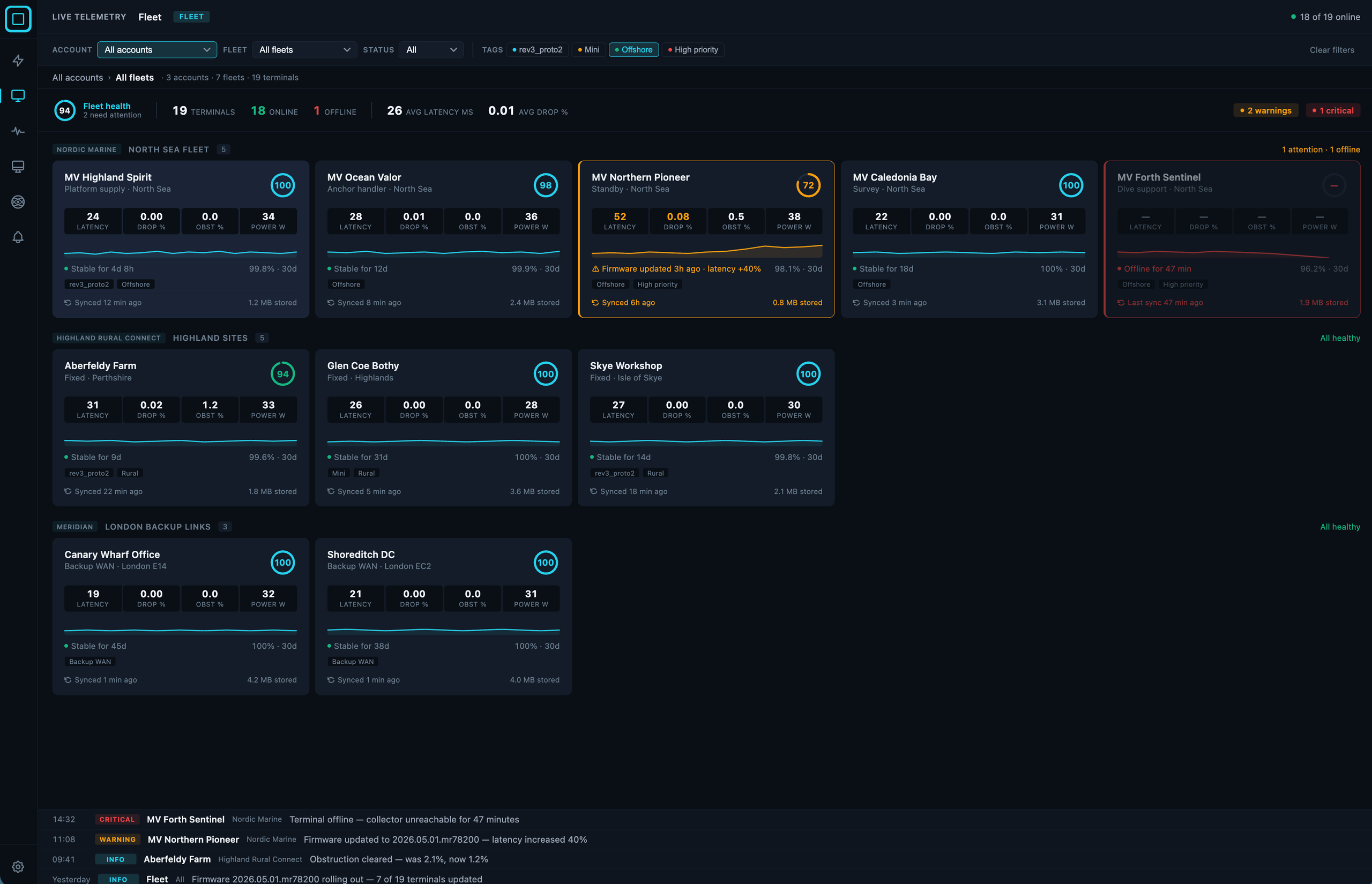
The product ships in three tiers. Nexus Telemetry Home ($35 one-time; £29 in the UK, €35 in the EU) provides everyday monitoring for individual users. Nexus Telemetry Pro ($199 one-time; £179 in the UK, €209 in the EU) adds session recording with GPS route mapping, PDF reporting, multi-target ping analytics, and a full network diagnostics suite for installers and professional operators. Nexus Telemetry Fleet extends Pro with centralised multi-terminal monitoring for resellers, marine operators, and distributed IT teams; Fleet is currently onboarding founding customers.
All telemetry data stays on the user's device. The application requires no cloud account and makes no external connections beyond licence validation and update checks. Public launch: April 2026.
About Liquidbinary
Liquidbinary Ltd is a UK software company registered in Scotland, founded in 2010 and trading continuously since. The company has focused on Starlink platform development since October 2022, when it was among the first development teams globally to be granted access to the Starlink Enterprise API at launch.
Between 2022 and 2025, Liquidbinary built and operated one of the first Starlink Enterprise management platforms for a major global reseller, handling telemetry from thousands of terminals across a global deployment. The platform was handed over to the client's internal team in December 2025. Nexus Telemetry is the productised expression of that experience: the same engineering depth applied to a commercially available desktop application.
About Paul Sutherland
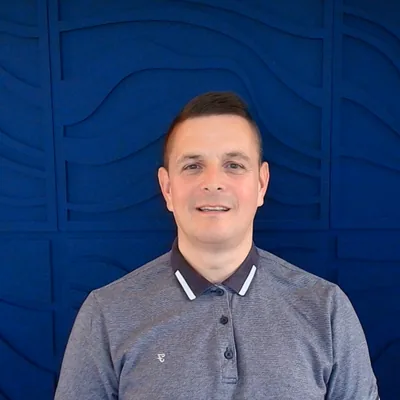
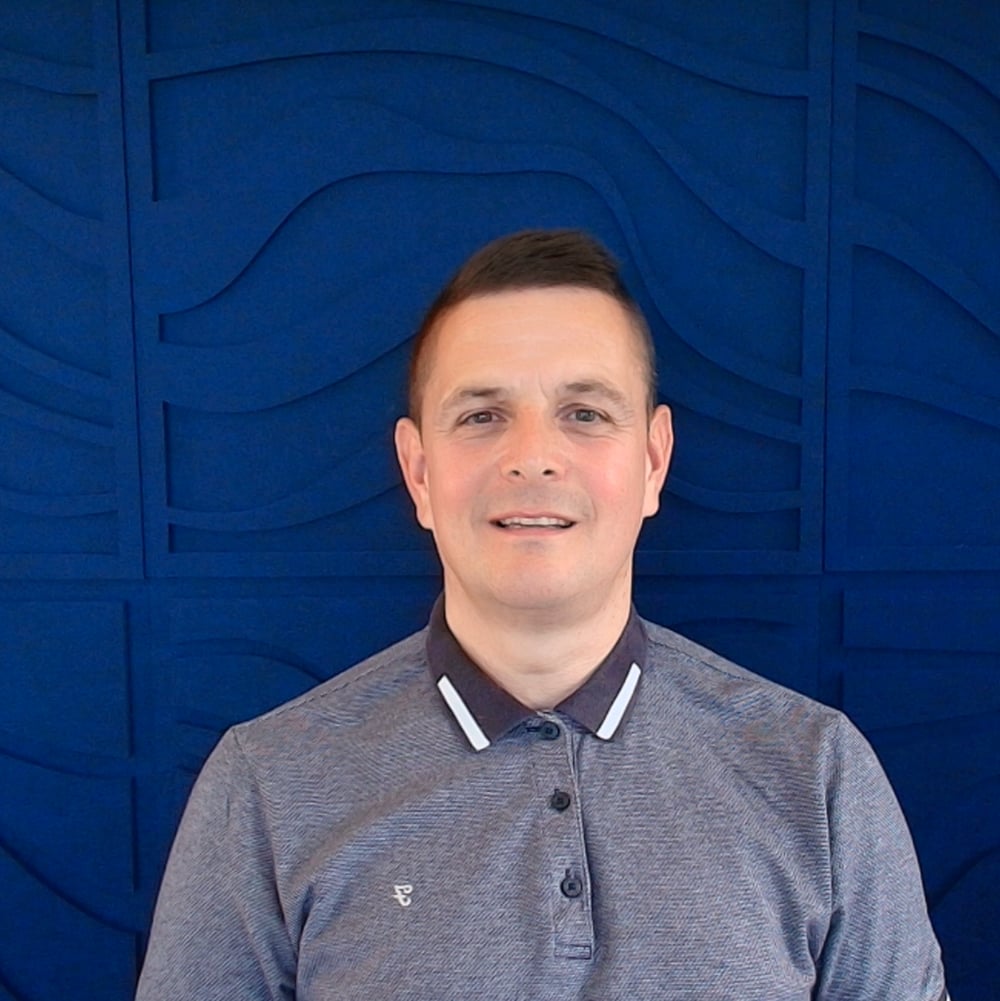
Paul Sutherland is the founder and technical lead at Liquidbinary Ltd. He has worked in software development since 2010 and has focused on Starlink platform engineering since the Enterprise API launched in 2022. He led the architecture and development of one of the first Starlink Enterprise management platforms and subsequently created Nexus Telemetry.
Paul writes about Starlink ecosystem development on his engineering blog at pds.codes and has been cited as a technical source on Starlink API changes by PCMag, Ars Technica, and ISPreview UK. He is available for interviews, technical commentary, and background briefings on Starlink ecosystem topics.
Canonical attribution for press
Paul Sutherland, Founder of Liquidbinary Ltd and developer of Nexus Telemetry
Technical Expertise
Topics Paul can speak to with direct operational or development experience:
Starlink Enterprise API Integration
Three years building on the Enterprise API from launch. Service line provisioning, telemetry endpoints, usage data, and the evolving API surface.
Multi-Terminal Fleet Monitoring Architecture
Designed two distinct fleet architectures, centralised SaaS and distributed collector models, for monitoring thousands of terminals at scale.
GPS Positioning & Tier-Segmentation Precedent
Analysis of the GPS removal from Starlink's gRPC interface and its implications for API access decisions, plan pricing, and platform developers.
Telemetry Processing at Scale
Real-time and batch processing of telemetry streams from global terminal fleets. Time-series storage, aggregation pipelines, and performance dashboards.
gRPC & Time-Series Telemetry
Direct experience with Starlink's gRPC telemetry interface, including undocumented endpoints, protocol changes, and building resilient local polling systems.
Platform Handover & Production Operations
Building an enterprise platform over three years and handing it to the client's internal team. Documentation, knowledge transfer, operational transition.
Prior Press Coverage
Selected citations and coverage, most recent first. Links open in new tabs.
26 May 2026 · Primary source on the tier-segmentation reversal, quoted on commercial-integrator pressure, the Roam-versus-Priority cost gap, and the platform precedent for developers.
11 May 2026 · Cited as a technical source on the GPS API removal, quoting the blog analysis, alongside academic researchers from UT Austin and Ohio State in the context of SpaceX's upcoming IPO.
28 April 2026 · Coverage of Starlink as a spoofing-resistant GPS backup for maritime users, illustrated with debug-data screenshots credited to Paul Sutherland.
23 April 2026 · Quoted on the practical impact of the removal for mobile users (RVs, vans, boats) and the security trade-off of the unauthenticated location feature.
22 April 2026 · Primary technical source on the original GPS API removal, covering third-party software impact, security and conflict-zone implications, and correcting the drone-weaponisation theory.
Quotable Positions
Pre-prepared positions for direct quotation. Each reflects Paul's analytical view on topics commonly covered by press in this space.
Tier-Segmentation in API Access
"Starlink has now established a precedent that API capabilities can be tied to service plan tiers rather than universally available. Anyone building on the platform has to factor in tier-segmentation risk as part of their roadmap planning, and that changes how integrators perceive the platform's stability as a commercial foundation. The structural question of why create operational overhead to gate a capability based on plan tier rather than make a clean decision either way is harder to answer than the technical question of what was changed."
— Paul Sutherland, Founder of Liquidbinary Ltd, developer of Nexus Telemetry
Cost Impact of GPS on Plan Selection
"The users who most need local GPS data, operators on RVs, boats, and remote installations using Starlink Mini, are exactly the users on Roam and Residential plans by definition. The cost differential between staying on those plans and moving to Priority is enormous, not incremental. Restoring a capability only for the tier that needed it least illustrates how platform decisions can create commercial friction that wouldn't exist with a cleaner architectural choice."
— Paul Sutherland, Founder of Liquidbinary Ltd, developer of Nexus Telemetry
Single-Dish vs Fleet Monitoring
"Monitoring one Starlink terminal is a different problem from monitoring a fleet of them. The Starlink app provides per-dish status and the Enterprise API provides cloud telemetry at fifteen-second intervals, but neither shows what is happening at every dish, second by second, in one place. Fleet monitoring requires a different architecture from single-dish monitoring, and treating them as the same problem with the same tool is part of why the gap has persisted in the market."
— Paul Sutherland, Founder of Liquidbinary Ltd, developer of Nexus Telemetry
Building Resilient Software on the Starlink Platform
"Three years of operating production software on the Starlink platform taught us that the API surface can change without notice, capabilities can be removed or restricted by tier, and protocol behaviour can shift between firmware versions. The resilience strategies that matter most are architectural rather than reactive: building for multi-source data where possible, designing for graceful degradation when endpoints disappear, and observing the platform continuously rather than assuming stability. Software built on someone else's commercial platform has to be designed for platform behaviour, not just platform capability."
— Paul Sutherland, Founder of Liquidbinary Ltd, developer of Nexus Telemetry
Press Imagery & Assets
All assets are licensed for press use with attribution to Nexus Telemetry / Liquidbinary Ltd. No form submission or account required — download what you need below, or request anything specific via the press contact.
Brand assets




Product screenshots





Fact Sheet
Contact
Response within one working day. Available for interviews, technical commentary, and background briefings on Starlink ecosystem topics. For urgent press enquiries, please note the deadline in your message.