Which Starlink Satellite Are You Connected To?
Short answer: you can't know for certain on consumer hardware, but you can make a reasonable estimate. Your dish knows exactly which satellite it's talking to, but it doesn't expose that over the local API. What you can do is combine the direction your dish is pointing with live orbital data to work out which satellites are likely candidates overhead. It's an approximate estimate rather than a precise readout, and this guide explains how it works and where it breaks down.
If you want the honest version rather than a gimmick: nobody selling you a "live satellite connection" readout on a standard dish is reading it from the dish. They're reconstructing it from the outside, matching the dish's own telemetry against public orbital data, one way or another. Understanding the difference is the point of this page.
Why the dish won't just tell you
The dish absolutely knows. It's a phased array constantly tracking and handing off between satellites, so internally it has a precise picture of what it's pointing at moment to moment. But that target information isn't published on the local gRPC interface the way latency, obstruction, and alignment are. SpaceX exposes plenty of telemetry, but not the live satellite identity.
So anyone who wants to answer "which satellite right now" has to reconstruct it from the outside, using two things the dish does give you, plus public data.
What you can actually use
The dish's pointing direction. Your dish reports its boresight: the azimuth and elevation the panel is physically aimed at. That's a bearing into the sky. One important catch, though: boresight is the panel's orientation, not the live beam direction. A Starlink dish is a phased array that steers its beam electronically across a wide field of view (over 100 degrees), so the satellite it's actually talking to can be well off the boresight bearing, anywhere within that cone. Boresight gives you the centre of the search, not the answer.
Live orbital data (TLEs). The orbits of the Starlink fleet are published as two-line element sets, updated regularly. With current TLEs you can compute, for any moment, where every Starlink satellite is in the sky relative to your location.
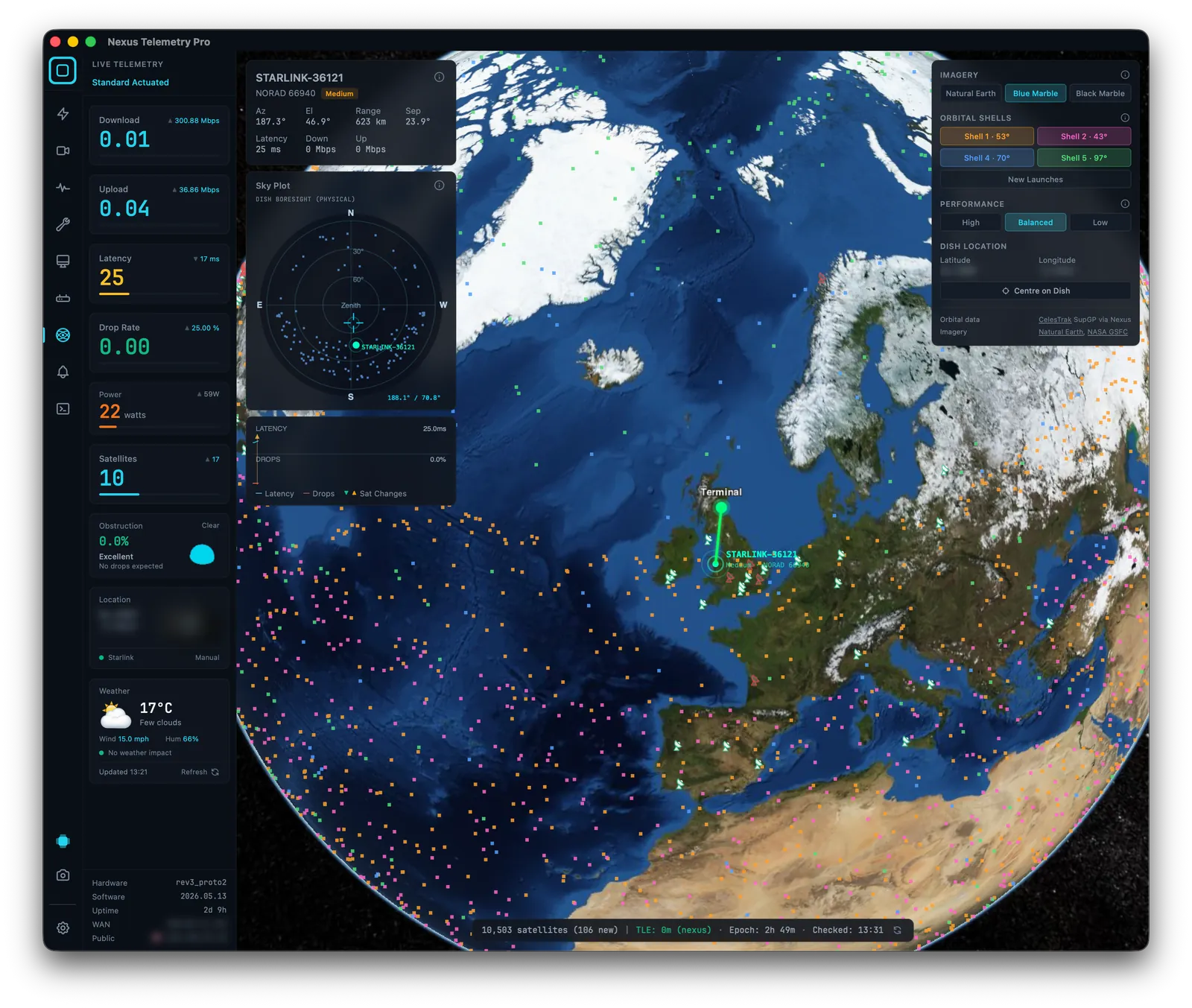
Put those together and the method is this: at this instant, the dish panel faces roughly this way, and these are the satellites currently within its field of view above you. You can narrow the field to plausible candidates, but because the beam can be anywhere in that wide cone rather than dead on the boresight bearing, this is a coarse first cut rather than a pinpoint.
Why it's an estimate, not a fact
Several things stop this being exact, and it's worth being honest about all of them.
The dish hands off constantly. Starlink reassigns your dish to a new satellite or beam on a fixed cycle, roughly every 15 seconds, and sometimes more often under obstruction or motion. By the time you've computed a match, the connection may already have moved on. Any answer is a snapshot of a moving target.
Boresight is the panel, not the beam. As above, the dish only reports where the panel faces, not where the electronically-steered beam is actually pointing, and the two can differ by tens of degrees. That alone makes a boresight-based estimate coarse.
Pointing direction has its own uncertainty. The boresight figure also has an error margin, and that margin grows when the dish is mounted near-flat or is in motion, which is exactly the mobile case where people most want this. Recent firmware has improved this: the dish now reports its orientation in a form that stays reliable even when the panel is nearly flat, so the situation is better than it used to be, but the estimate is still an estimate.
Several satellites can be in view at once. With over 10,000 satellites in the constellation, a wide field of view usually contains multiple candidates at any moment. You can rank them, but you can't always separate them cleanly.
TLE data ages. Orbital elements drift between updates, on the order of a kilometre or more per day, so it's worth refreshing them every day or two. Fresh TLEs give a better fix; stale ones degrade the estimate.
None of this makes the exercise pointless. On a fixed, well-tilted dish with fresh orbital data, you can narrow the likely satellite to a small set, and watching the constellation move overhead is genuinely informative. But it's an approximate, probabilistic estimate, not a confirmed identity, and anyone claiming certainty on consumer hardware is overstating what's possible.
How to see this yourself
You need software that reads your dish's pointing direction and overlays it on live orbital positions. Nexus Telemetry does this: it pulls your dish's boresight, fetches current Starlink TLEs, and shows the satellites within your dish's field of view on a 3D globe, highlighting the likely candidates. It's presented as an estimate, because that's honestly what a boresight-based approach is, but it's a genuinely useful and rather beautiful way to watch the constellation work overhead.
The same view depends on knowing your location, which used to come from the dish's own GPS. Since Starlink removed that from the local API, you'll want a location source set up first.
What the GPS removal means, and how to work around it →
The short version
You can't read your exact satellite off a consumer dish, because the dish doesn't publish it. You can estimate the likely candidates by matching the dish's pointing direction against live orbital data, but bear in mind the dish reports its panel orientation rather than the actual beam direction, so this is an approximate narrowing, not a pinpoint, and the target changes roughly every 15 seconds. It works best on a fixed, well-tilted install with fresh orbital data. Software like Nexus Telemetry does the matching and shows it honestly as an estimate.
You can watch your dish track the constellation with a free trial of Nexus Telemetry.